
Negative equity occurs when a property’s value is less than the outstanding balance on the mortgage. Being ‘underwater’ is a colloquial term for negative equity.
But what is equity? Equity is the difference between your home’s value and the outstanding amount to pay on the mortgage. In general, your equity in your home increases as you make repayments over time.
How Does Negative Equity Occur?
Falling home values generally cause negative equity.
Let’s say you bought a house worth $500,000 with a deposit of 10%, $50,000, and you took out a loan of $450,000. After a year, you repay $25,000 of the principal. You owe your lender 425,000, (450,000) minus the amount of the principal repaid ($25,000). But home prices have dropped, and your home is now worth just $400,000. If your house sells at $400,000 today, you will owe your lender $25,000 more than you received for it, so you have negative equity of $25,000.
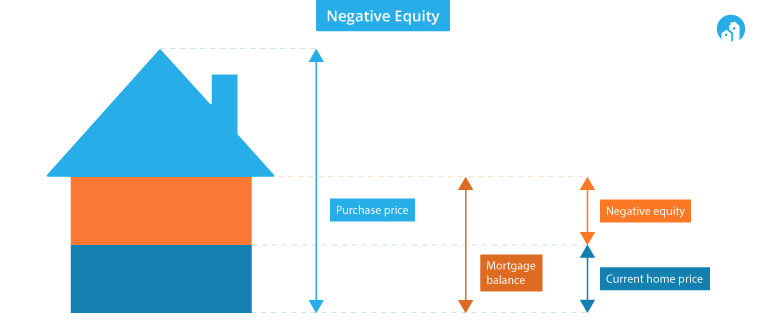
Keep in mind that paying only interest will increase the risk of negative equity because the monthly repayment doesn’t contribute to decreasing the value of your debt.
As a historical example, high iron ore and coal prices caused strong growth in mining towns across Australia in the early 2000s. Many investors bought into the local housing market, and property prices increased. When commodity prices fell, the housing demand in these mining towns fell – and so did the property values. Investors who had paid high prices ended up with homes with negative equity.
Does negative equity matter if I’m not selling?
If you can comfortably afford your repayments and plan to stay in your home, negative equity may have little immediate effect. A fall in your property’s value alone doesn’t put you in mortgage default.
A lower valuation can make it harder to refinance or borrow against your home. If a job loss, separation or relocation means you need to sell, the sale proceeds after costs may fall short of what you owe. If you think you’ll struggle to make a repayment, speak to your lender’s hardship team early.
Why are recent first-home buyers more exposed to negative equity?
Buying with a small deposit means you start with less equity to absorb a fall in the property’s value. The risk is greatest soon after purchase, when you may have paid off relatively little of the loan. If you’re on interest-only repayments, your required payments don’t reduce the amount you borrowed during the interest-only period. If you added Lenders Mortgage Insurance (LMI) to the loan, that premium forms part of your balance and reduces your starting equity.
In its October 2026 Financial Stability Review, the Reserve Bank estimated that fewer than 1% of borrowers were in negative equity. It found that recent buyers and those who borrowed a high share of their property’s value were more exposed, including first-home buyers using the Australian Government 5% Deposit Scheme.
In November 2026, Moody’s Ratings expected more borrowers to fall into negative equity over the following year. As at 31 May 2026, Moody’s found that 0.39% of borrowers in the mortgage pools it studied were in negative equity. In its modelling, a 10% price fall from May levels would take that share to around 1.5%, and a 15% fall would take it to around 4.6%. These are scenarios for the loans Moody’s studied. Your equity depends on your current loan balance and your property’s value.
How do you work out if you’re in negative equity?
Subtract what you currently owe on your home loan from your home’s estimated current value. If the result is below zero, you’re in negative equity.
For example, if your home is worth $736,000 and you owe $760,000, you’re $24,000 in negative equity.
- Check what you owe. Use your latest home loan balance and include any other loan splits secured by the property. If you’re planning to sell, ask the lender for a payout figure for the expected settlement date.
- Estimate what your home is worth today. Start with recent sales of comparable properties. Online estimates and suburb medians are rough guides. If you want to refinance, the new lender will use the valuation it accepts, which may differ from an online estimate or an agent’s appraisal.
- Subtract the loan balance from the estimated value. A result below zero means you’re in negative equity on that estimate. If the numbers are close, check a range of plausible values to see how much difference the valuation makes.
You can also use our Home Equity Calculator to check this.
What happens if your home falls in value after you buy with a 5% deposit?
Say you buy for $800,000, put down $40,000 and borrow $760,000. Here’s how a fall in property value would affect your equity if your loan balance stayed at $760,000.
| Change in property value | Estimated property value | Your equity |
|---|---|---|
Purchase price | $800,000 | $40,000 |
Down 3% | $776,000 | $16,000 |
Down 5% | $760,000 | $0 |
Down 8% | $736,000 | −$24,000 |
In this example, a 5% fall uses up your starting equity. An 8% fall leaves you owing $24,000 more than the property is worth, before selling costs. If you’ve already paid down some principal, use your lower balance to work out where you stand.
What Should You Do If You’re In Negative Equity?
If you’re staying put and can afford your repayments
Keep up your scheduled repayments. If you have room in your budget after allowing for emergencies, extra payments towards the principal can help close the gap. Check your loan terms first, especially if you’re on a fixed rate. Your equity can still fall if the property loses value faster than you reduce the loan balance.
If you have an offset account, you can keep spare cash accessible while reducing the interest you’re charged. Money in the offset is held separately from the loan. If you want to reduce the balance immediately, ask your lender how to make a principal payment and check what cash you’ll have left for emergencies.
If you’re considering renovating
Start with essential repairs that prevent further damage. If you’re considering improvements to lift the property’s value, get written quotes, allow for overruns and look at comparable renovated sales. If the numbers are close or you need finance, ask about a valuation before committing. Spending more on a property than the work adds in value is called overcapitalising.
For example, if you borrow $20,000 against your home for a renovation and it adds only $12,000 to the value, your negative equity grows by $8,000 before interest and fees. If you’re using savings, compare the likely increase in value with what the same cash could do if you paid down the loan, and make sure you can still cover unexpected expenses.
A standard equity top-up is generally difficult when you’re already in negative equity. For some major projects, a lender may consider what the home would be worth once the work is finished. Approval still depends on the lender’s valuation, lending criteria and your ability to repay. If you used the Australian Government 5% Deposit Scheme, check with your participating lender before borrowing more against the property, as this can affect the guarantee.
If you want to refinance
Refinancing with a new lender is generally difficult when your loan balance exceeds the property value the lender accepts. The lender will assess both the property and your ability to afford the new loan. If you mainly want a better rate, ask your current lender for a rate review. If switching is possible, compare the likely savings with any LMI, break costs or other fees.
Your refinance options can change while you still have positive equity. Say you owe $624,000 on a home valued at $800,000. Your loan-to-value ratio (LVR) is 78%. If a lender values the home at $760,000, your LVR rises to about 82%, even though you still have $136,000 in equity. Moving above 80% can change which loans are available to you and may mean paying LMI when you switch.
If you bought through the Australian Government 5% Deposit Scheme, check the guarantee before you apply. Housing Australia says you may be able to retain it when refinancing with another participating lender if you meet the scheme’s conditions. Switching to a non-participating lender ends the guarantee.
If you need to sell
Ask your lender for an estimated payout figure and compare it with what you expect to receive after agent fees, conveyancing and other selling costs. If the net proceeds won’t cover the payout, speak to your lender before signing a sale contract. Ask what the lender needs to release the mortgage at settlement and how it would handle any amount still owing. A conveyancer or solicitor can help you understand what needs to be in place before you commit.
If you can cover the gap with savings, ask your lender to confirm the amount you’ll need at settlement. If you can’t, ask whether the lender would agree to a repayment arrangement for the shortfall and get any agreement in writing.
If you’re worried about missing a repayment
Contact your lender’s hardship team as soon as you think you’ll struggle to make a repayment. Depending on your circumstances, the lender may be able to temporarily change your payments or offer another hardship arrangement. For free, independent financial counselling, call the National Debt Helpline on 1800 007 007.
Ask what you’d pay during and after the arrangement, whether interest would continue to accrue and how much you could owe at the end. A lower payment can ease pressure now while slowing how quickly you rebuild equity.
We Are Here To Help!
If you are under mortgage stress or want to know your available options when in negative equity, then Home Loan Experts’ experienced mortgage brokers are here to help. We will assess your situation and help you determine the best option. Call us on 1300 889 743 or fill in our free online assessment form today!
Frequently Asked Questions (FAQs) About Negative Equity
Does the 5% Deposit Scheme protect me from negative equity?
No, the 5% Deposit Scheme does not protect you from negative equity.
The scheme helps eligible buyers purchase with a small deposit without paying LMI. The government guarantee protects the participating lender. Your loan balance can still exceed the value of your home, and you may still owe money if you sell and the proceeds fall short.
Does negative equity affect my credit score?
Can I have positive equity and still owe money after selling?
Still need answers? We're here to help!
Ask an expertOur team of mortgage experts will assist you within 24 hours.