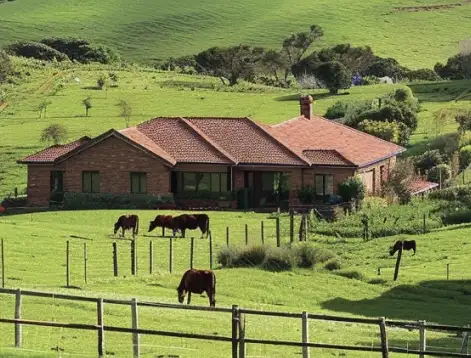
What Is A Hobby Farm?
A hobby farm is usually a rural property used for small-scale farming and lifestyle purposes, rather than as a full commercial farming operation.
People often buy hobby farms for the lifestyle, to grow their own produce, keep a few animals, and enjoy a more hands-on, self-sufficient way of living. That might include running chickens, a few head of cattle or sheep, growing fruit and veg, or just making better use of the land.
While some hobby farms can bring in a bit of extra income, they are generally not set up to be the owner’s main source of income. The focus is usually more on lifestyle, personal enjoyment, and small-scale production than on running a profit-driven farm business.
In many ways, a hobby farm can look similar to a working farm, on a smaller scale and with different priorities.
Discover Your Hobby Farm Borrowing Power
How Much Can You Borrow For A Hobby Farm?
| Land size | Maximum borrowing | Notes |
|---|---|---|
| Up to 10 ha | Up to 95% of the property value | |
| More than 10 ha and up to 50 ha | Up to 90% | If the property is close to a major town |
| More than 10 ha and up to 50 ha | Up to 80% | If the property is not close to a major town |
| More than 50 ha and up to 60 ha | Up to 80% of the property value | |
| More than 60 ha and up to 100 ha | Up to 70%–80% of the property value | Assessed on a case-by-case basis |
| Over 100 ha | Varies | May not be considered a hobby farm by banks |
Other lending scenarios
- Investment properties: Borrowing is generally restricted to 90% of the property value, although you may be able to borrow up to 95% if the property is less than 2 ha.
- Vacant land: You may be able to borrow up to 95% of the property value, depending on the size of the block and lender criteria.
- Commercial farms: Finance may be available for agricultural businesses, including equipment finance.
- Guarantor loans: You may be able to borrow up to 100% with select lenders only.
- Discounts: Competitive professional package and basic loan discounts may be available for properties up to 100 ha.
The main problems banks have with financing a hobby farm are the improvements that typically need to be made and the use the farm is put to.
When Is A Hobby Farm Considered Income-Producing?
The test for most valuers is whether there is an ability to offset business losses from a farm against other income.
Typically, this is where:
- Turnover from the business activity is at least $50,000.
- The business has produced a taxable profit in 3 of the last 5 years, including the current year.
- The value of the property carrying on a business is at least $500,000.
For example, you will often find hobby farms with cattle or agistment (the contract for taking in and feeding horses or other cattle) where the owners want to earn at least $20,000 to get the ability to claim their losses from the farm against other income forms.
Do you intend to develop the property for significant agricultural activities?
Do you need some of this income to prove that you can afford the loan?
If so, it’s likely that the valuer will class the property as income-producing.
What Should I Look For When Buying A Hobby Farm?
Check that the land is suitable for what you’re planning to use it for
This can include fertile soil for growing produce and, for the purposes of caring for animals, fields for grazing and clear access to water sources, such as ponds and lakes.
If you’re buying vacant land then check with council to confirm that you are allowed to build a dwelling on the property.
Check with council regarding zoning and infrastructure projects
Zoning changes all of the time and planned or ongoing infrastructure or commercial projects can have a major affect on your ability to run a hobby farm. For example, a new motorway can affect the peace and quiet that you were after in the first place, while, from a practical perspective, a new mining or gas project can have a massive effect on the health of the surrounding environment and your ability to grow produce.
In terms of actually getting approved for a hobby farm loan, did you know that there are lending restrictions on bushfire prone properties, many of which are located in the same rural areas as lifestyle farms?
Check that you’re getting what you pay for
Sometimes the farm will come with everything you need including built-in stables or houses for animals, troughs, feeding dispensers and fences. That’s great but it also means you have to ensure that you’re getting what you pay for, that is, making sure all of the amenities are in good condition and to code.
Legal requirements
Be aware of local council restrictions as well as state and federal laws and licensing requirements regarding the use of land and owning farm stock.
For more resources and tips on lifestyle farms, go to farmstyle.com.au.
What Do Banks Assess When Approving A Hobby Farm Loan?
Banks can assess hobby farms in several ways, depending on the property’s location and size.
Land size: There is technically no maximum land size. However, to qualify with most banks the land must be less than 10ha. Some banks can consider up to 50ha and one can consider any size land as long as the property is not being used for business or income-producing purposes.
Banks are likely to be very conservative with properties over 200 hectares.
Location: Each lender has their own postcode restrictions. At least two of our lenders have no postcode restrictions at all, although, remote properties will always be difficult to finance.
Access: The land must have easy access using an all-weather road. Dirt roads are fine as long as they are well maintained.
Services: The land must be within range to be connected to the electricity grid without excessive costs or have solar power. Town water and sewerage services aren’t required as many Australian properties have tank water or septic tanks instead. Fully-serviced and partially-serviced blocks are both acceptable.
Zoning: Land can be zoned rural, rural residential or the equivalent for your state. Be careful with land that is zoned industrial, commercial or for farm use as they are generally not accepted or may be considered as a commercial farm unless it’s clear they can’t be used as a home. A good rule of thumb is that if the land you are buying is subject to GST then it would be considered as a commercial property by the banks.
Land use: The land can only be used for personal or investment purposes, not as a commercial farm. Hobby farms with minor farm improvements and that don’t produce income from farm production are usually accepted.
Invest In A Hobby Farm
Hobby farm loans can be more complex than standard home loans. A specialist broker can help you understand how lenders assess factors such as land size, location, zoning and any income the property may generate. They can also help structure your application to better meet lender requirements.
Call us on 1300 889 743 or enquire online, and one of our mortgage brokers specialising in hobby farms will be in touch.
Frequently Asked Questions
Are There Location Restrictions For Hobby Farm Loans?
Yes. Many lenders apply postcode restrictions when assessing hobby farm loans. Properties located near major towns or regional centres are generally preferred, while remote or isolated properties are often harder to finance and may be subject to lower loan-to-value ratios. Some lenders have more flexible location policies, but the available options are usually more limited.
Can I Use Farm Income To Qualify For A Hobby Farm Loan?
Why Are Hobby Farm Loans Harder To Get Approved?
Still need answers? We're here to help!
Ask an expertOur team of mortgage experts will assist you within 24 hours.