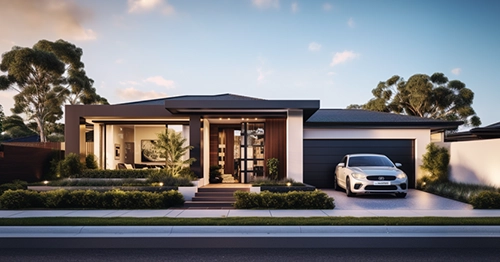
A townhouse loan is a specialized mortgage designed for purchasing a multi-level dwelling that shares one or more walls with an adjacent property. Most lenders will allow you to borrow up to 95% of the property value, provided the townhouse is in a low-risk postcode and meets acceptable strata or freehold title requirements.
Townhouses are highly sought after by first home buyers and investors because they offer an urban lifestyle at a lower entry price than standard detached houses. However, some banks take a conservative view on townhouses, restricting Loan to Value Ratios (LVRs) due to oversupply fears or strata title rules.
Fortunately, not all banks have the same lending criteria. At Home Loan Experts, our award-winning mortgage brokers know which lenders take a more favorable approach.
How Much Can You Borrow for a Townhouse?
You can generally borrow between 80% and 95% of a townhouse’s property value, depending on your residency status, employment type, and whether you are a first home buyer or an investor.
With a guarantor, you can potentially borrow up to 100% of the purchase price without paying LMI.
The maximum borrowing limits for townhouse loans are following:
- First home buyers: Up to 95% of the property value.
- Investors: Up to 95% of the property value.
- Low Doc / Self-Employed: Up to 80% of the property value.
- Guarantor Loans: Up to 100% of the purchase price, plus the costs of stamp duty and legal fees, effectively allowing you to avoid Lenders Mortgage Insurance (LMI) entirely.
To find out exactly how much you qualify for, use an online Borrowing Power Calculator.
First Home Buyer Schemes For Townhouses
Because townhouses are popular entry-level properties, first home buyers can access several government schemes to help secure a townhouse loan. These include the First Home Guarantee (FHBG), the First Home Owner Grant (FHOG), and state-specific stamp duty concessions.
These government initiatives act as massive drivers for townhouse purchases because they help buyers bypass strict bank deposit rules and save thousands in upfront costs.
First Home Guarantee (FHBG)
Allows eligible first home buyers to purchase a townhouse with a deposit of as little as 5% without having to pay LMI. The government guarantees the remaining 15%.
First Home Owner Grant (FHOG)
A state-based grant that provides a cash boost (typically between $10,000 and $30,000) for buyers purchasing or building a brand-new or substantially renovated townhouse.
Stamp Duty Concessions
Most states offer full or partial stamp duty exemptions for first home buyers purchasing properties under a certain price threshold, heavily reducing upfront purchasing costs.
Why Do Some Banks Restrict Townhouse Loans?
Some banks restrict townhouse loans because they view high-density strata properties as a higher financial risk. These restrictions are usually driven by oversupply issues in specific postcodes, limited mass-market appeal, and a higher risk of property valuation shortfalls compared to detached houses.
According to lending guidelines, banks change their appetite for units and townhouses on a semi-regular basis to mitigate risk in their loan books. Here are the three main reasons you might face lending hurdles:
1. High-Density Postcode Restrictions
Lenders maintain strict data on how well certain property types sell in specific areas. In parts of the country, particularly inner-city areas there is an oversupply of high-density units and townhouses. If a bank has to sell your property quickly due to a mortgage default, an oversupplied market means it may take longer to sell or force the bank to accept a lower sale price. As a result, lenders apply postcode restrictions to limit their exposure.
2. Valuation Challenges
When banks order a property valuation, the valuer relies heavily on comparable sales in the local area. While townhouse developments are increasingly popular, they can be rare in small towns on the outskirts of the CBD. With few comparable sales, valuers take a conservative approach. This can lead to a valuation shortfall, meaning you may need a larger deposit to qualify for the loan.
3. Strata Title vs. Torrens (Freehold) Title
A Torrens (Freehold) title means you own both the building and the land it sits on completely. A Strata title means you own your specific unit, but you share ownership and financial responsibility for common areas (like driveways and roofs) through a body corporate.
Lenders generally prefer Torrens title townhouses because they lack body corporate restrictions and typically experience better long-term capital growth. Strata title townhouses are often cheaper but come with strict by-laws and shared maintenance risks. Freehold townhouses are becoming increasingly rare.
How Do Strata Fees Affect Your Borrowing Capacity?
Strata fees directly reduce your maximum borrowing capacity. Banks factor mandatory body corporate levies, sinking fund contributions, and strata insurance into your ongoing living expenses, which increases your Debt-to-Income (DTI) ratio and lowers the total amount the bank will lend you.
When calculating your serviceability, lenders rigorously review your monthly commitments. High strata fees in premium townhouse complexes (which might include shared pools or gyms) can significantly tighten your budget. It is a crucial detail to factor into your budgeting before applying for pre-approval.
Pros and Cons of Buying a Townhouse
To help you decide if a townhouse is the right property type for your financial goals, consider the following advantages and disadvantages:
| Feature | Pros of Buying a Townhouse | Cons of Buying a Townhouse |
|---|---|---|
| Affordability | Lower entry price than a standard detached house, making it ideal for first home buyers. | Strata titles often yield slower capital growth compared to freehold detached houses. |
| Maintenance | The body corporate handles external maintenance, landscaping, and building insurance. | You must pay mandatory quarterly body corporate (strata) fees, which impact your budget. |
| Location | Often located in desirable, high-density urban areas closer to CBDs and modern amenities. | Postcode restrictions from lenders may require you to provide a larger deposit (e.g., 20%). |
| Lifestyle | Access to shared amenities (BBQ areas, security) and a strong sense of community. | Shared party walls mean less privacy and noise control compared to a standalone house. |
| Ownership | Excellent rental yields for investors due to high tenant demand. | Strict strata by-laws can restrict renovations, pet ownership, and property usage. |
The Step-by-Step Townhouse Loan Process
Securing a townhouse loan follows a linear process: determining your borrowing power, getting pre-approval, arranging property valuation, and finally reaching formal approval and settlement. A mortgage broker can guide you through these steps to ensure you meet all lending criteria.
Follow this step-by-step buyer’s journey to get your townhouse loan approved smoothly:
Step 1: Budgeting and Borrowing Power
Before house hunting, use a Borrowing Power Calculator to understand your limits. Factor in your deposit, potential strata fees, and stamp duty costs. Don’t just look at bank policies, speak to a broker who can align your financial situation with the right lender.
Step 2: Conditional Pre-Approval
Apply for conditional pre-approval. This gives you a clear budget and shows real estate agents you are a serious buyer. Pre-approval typically lasts for 90 days.
Step 3: Property Valuation And Strata Review
Once you find a townhouse, the lender will order a property valuation to ensure the purchase price aligns with the market value. During this phase, you should also review the strata report (if applicable) to check for hidden costs, poor sinking funds, or upcoming special levies.
Step 4: Unconditional Approval And Settlement
After the valuation is accepted and all conditions are met, the lender will issue unconditional (formal) approval. You will then sign the loan documents, pay your deposit, and proceed to settlement where the property officially becomes yours.
Townhouse Construction And Development Loans
If you are building a townhouse, you can typically borrow up to 95% of the land and construction costs for up to 4 units.
If you construct 5 to 10 units, it becomes a residential development loan at an 80% LVR. Anything above 10 units is classed as a commercial development loan (70% LVR max).
Up to 4 Units (Residential)
You can borrow up to 95% LVR for four dwellings built side-by-side, regardless of whether they are two or three storeys high.
5 to 10 Units (Residential Development)
Strong applicants can borrow up to 80% LVR for 5 to 10 units of residential development.
11+ Units (Commercial Development)
Once you exceed ten units, banks classify this as commercial lending, severely restricting your LVR to 70%.
Note: For all construction loans, banks manage risk by releasing funds in stages (progress payments) rather than a single lump sum.
Do You Need A Townhouse Loan?
Banks change their appetite for units and apartments on a semi-regular basis as a way of mitigating risk in their loan book.We know which lenders take a less conservative approach to townhouse loans!
Call on 1300 889 743 or complete our free assessment form to discover if you qualify.
Frequently Asked Questions
Are Townhouses Harder To Get A Mortgage For?
Yes, townhouses can be slightly harder to finance than standard detached homes. Lenders enforce stricter loan-to-value ratio (LVR) limits and postcode restrictions in areas with an oversupply of high-density housing, meaning you might need a larger deposit to secure a loan.
Can I Use The FHOG To Buy A Townhouse?
What Credit Score Do I Need For a Townhouse Loan?
Still need answers? We're here to help!
Ask an expertOur team of mortgage experts will assist you within 24 hours.