
What is the Help to Buy Scheme?
The Australian Government Help to Buy Scheme can help eligible Australians buy a home with a deposit starting from 2%.
Unlike the Australian Government 5% Deposit Scheme, Help to Buy is a shared-equity scheme. The Government contributes towards the purchase price and receives a corresponding percentage interest in the value of your home.
You still own the property, and your name is on the title. However, while the Government holds an equity share, it shares proportionally in increases or decreases in the property’s value.
For the 2026-27 financial year:
- A minimum 2% deposit is required
- The Government can contribute between 5% and 30% towards an existing home
- The Government can contribute between 5% and 40% towards a new home
- 10,000 Help to Buy places are available each year
- Individual applicants can have a taxable income of up to $103,000
- Joint applicants and eligible single parents can have a combined taxable income of up to $165,000
- Help to Buy is available across all Australian states and territories
Importantly, qualifying for Help to Buy does not guarantee that you will qualify for the home loan. You must also meet a Participating Lender’s lending and serviceability requirements.
Who Are The Participating Lenders In Help to Buy?
As of 6 October 2026, Help to Buy is available through four participating lending institutions:
- Commonwealth Bank CBA
- Bank Australia
- Teachers Mutual Bank Limited, through Teachers Mutual Bank, Health Professionals Bank, Firefighters Mutual Bank and UniBank
- Queensland Country Bank
Not every participating lender offers Help to Buy through the same channel. Bank Australia accepts broker applications, Teachers Mutual Bank Limited began a phased broker rollout on 6 October 2026, and Queensland Country Bank offers the scheme through both its retail and broker channels.
Commonwealth Bank currently directs Help to Buy applications through its own home lending channel.
How Does Help To Buy Actually Work?
Help to Buy can bridge the gap between the deposit you contribute, what a lender will lend you and the price of the home you want to buy.
For example, suppose you buy an eligible new home worth $400,000 and qualify for the maximum 40% Government contribution.
Your purchase could look like this:
- Your deposit: $8,000 (2%)
- Home loan: $232,000 (58%)
- Government contribution: $160,000 (40%)
- Purchase price: $400,000
- $8,000 + $232,000 + $160,000 = $400,000
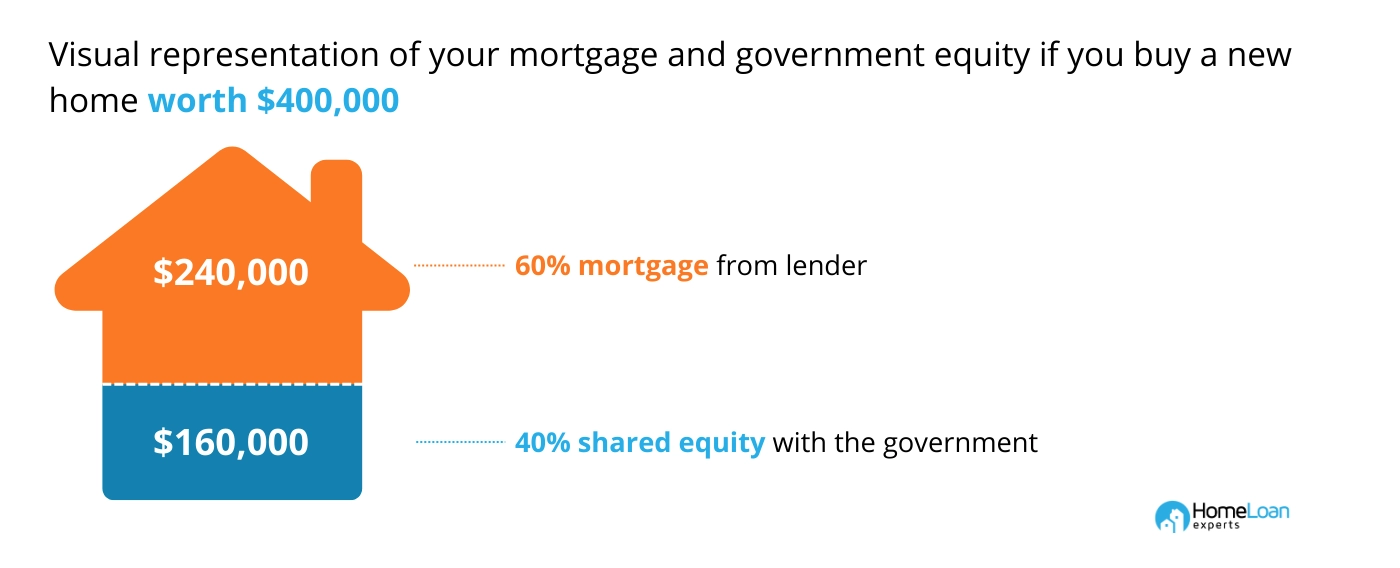
You make your normal home loan repayments on the $232,000 borrowed from the lender.
You don’t make monthly repayments, pay rent or pay interest to the Government on its $160,000 contribution while you remain in the scheme. However, the Government contribution is not a grant. In this example, the Government has a 40% financial interest in the value of the property.
Is The Maximum Government Contribution Automatic?
No, the maximum government contribution is not automatic under Help to Buy.
The headline figures of 30% for an existing home and 40% for a new home are maximums, not the amount every eligible buyer receives.
The Government contribution can generally range from:
- 5%-30% for an existing home
- 5%-40% for a newly built home
You are expected to contribute the maximum amount you can reasonably afford, while your Participating Lender assesses how much you can borrow.
The Government contribution then helps bridge the remaining eligible gap.
This means Help to Buy is not designed to let someone deliberately borrow less simply to obtain the maximum Government contribution.
Help To Buy Eligibility Calculator
Discover your eligibility for the Help To Buy Scheme with our user-friendly calculator. By answering a few simple questions, you can instantly find out if you meet the criteria and qualify for the scheme.
Do You Pay Lenders Mortgage Insurance With Help To Buy?
No. Help to Buy is structured so eligible participants do not need to pay Lenders Mortgage Insurance (LMI) when entering the scheme.
However, it is important to understand why.
Help to Buy is not a Government home loan guarantee.
Instead, the Government contributes equity towards the property, reducing the amount that needs to be funded by your home loan.
This is different from the Australian Government 5% Deposit Scheme, where the Government provides a guarantee to the lender but does not take an equity share in your property.
What Are The Help To Buy Income Limits In 2026-27?
For applications during the 2026-27 financial year:
- Individual applicant: Taxable income must be $103,000 or less
- Single parent or legal guardian: Taxable income must be $165,000 or less
- Joint applicants: Combined taxable income must be $165,000 or less
The important word is taxable.
Help to Buy does not use your gross salary for this test. Your eligibility is assessed using the taxable income shown on your most recent Australian Taxation Office Notice of Assessment.
For 2026-27 applications, this is generally your Notice of Assessment for the 2025-26 financial year.
There is no discretion to exceed the income cap because the additional income came from something unusual, such as a bonus, redundancy payment or another one-off taxable event.
Your lender will separately assess the income it can use when calculating your home-loan borrowing capacity.
Who Can Qualify For Help To Buy?
To be eligible, you generally need to:
- Be at least 18 years old
- Be an Australian citizen
- Apply individually or jointly with one other eligible applicant
- Meet the relevant taxable-income limit
- Contribute at least 2% of the purchase price
- Obtain an eligible home loan from a Help to Buy Participating Lender
- Buy within the applicable property price cap
- Live in the property as your principal place of residence
- Not own or beneficially own another property in Australia or overseas
- Meet the scheme’s financial-capacity requirements
- Not receive assistance from another Government shared-equity, home-loan or guarantee scheme for the same purchase
You can still potentially use assistance such as eligible first-home-owner grants, stamp-duty concessions, and the First Home Super Saver Scheme (FHSSS).
Do You Have To Be A First-Home Buyer?
No.
Help to Buy is not restricted to first-home buyers.
Someone returning to home ownership can potentially qualify if they meet the current property-ownership and other eligibility requirements.
There are also specific exceptions for some single parents who currently own property jointly and are buying out another owner’s share or disposing of their existing interest.
What If You Don't Qualify For The Help To Buy Scheme?
Not meeting the Help to Buy eligibility criteria doesn’t necessarily mean you need to save a 20% deposit.
Some specialist lenders offer 98% LVR home loans, allowing eligible borrowers to buy a property with a deposit as low as 2% without using a government shared-equity scheme.
These loans may be worth exploring if you:
- Earn more than the Help to Buy income limit.
- Are an Australian permanent resident or hold another eligible visa.
- Want to purchase without giving the government an equity share in your home.
- Are buying an investment property rather than a home to live in.
- Don’t meet Help to Buy’s property ownership or other eligibility rules.
Unlike Help to Buy, a specialist 98% home loan doesn’t provide a government contribution towards your purchase. You’ll need to qualify for the larger mortgage repayments, and additional lender fees may apply.
Home Loan Experts can help you compare these options based on your deposit, borrowing capacity and property.
Learn more about 98% Home Loans and 2% Deposit Options.
Help To Buy vs a 98% Home Loan: What’s the Difference?
Both options may allow eligible buyers to purchase with a 2% deposit, but they work very differently.
| Feature | Help to Buy | Specialist 98% LVR Home Loan |
|---|---|---|
| Minimum deposit | 2% | As low as 2% for eligible borrowers |
| Government contribution | Up to 30% for existing homes and 40% for new homes | None |
| Government equity share | Yes | No |
| Income caps | Yes | Subject to lender serviceability, not Help to Buy income caps |
| First-home buyers only? | No | No |
| Investment properties | Not eligible | Eligible under certain specialist products |
| Lenders Mortgage Insurance | Not required | Some products charge an alternative fee instead of LMI |
| Mortgage size | Reduced by the government’s contribution | Up to 98% of the property’s value, subject to product rules |
Can A Mortgage Broker Help You Apply For Help To Buy?
Yes, but broker access depends on the Participating Lender.
This is different from simply asking whether a lender participates in Help to Buy.
A lender can offer Help to Buy through its own direct channel without necessarily making the scheme available to every mortgage broker.
From 6 October 2026, broker access has expanded.
Teachers Mutual Bank Limited has started allowing its first cohort of accredited and trained mortgage brokers to offer Help to Buy through its brands.
The rollout is being phased:
- The first trained broker cohort gains access from 6 October 2026
- Another group is expected to be onboarded by the end of October
- Broader broker access is expected to continue during 2027
This gives buyers who use mortgage brokers another potential pathway into Help to Buy, rather than just one broker channel.
However, not every broker will automatically have access to every participating Help to Buy lender.
Before relying on a particular lender, check whether your broker is currently accredited and able to submit Help to Buy applications through that lender.
What Are The Help To Buy Property Price Caps?
The property must be priced at or below the Help to Buy cap applying to its location.
The Government receives an equity interest in return for its contribution, so the figures below represent the maximum potential Government contribution, not money that is simply given to the buyer.
| Region | Property Price Cap | Maximum Government Contribution: New Home (40%) | Maximum Government Contribution: Existing Home (30%) |
|---|---|---|---|
| NSW – Sydney and eligible regional centres | $1,300,000 | $520,000 | $390,000 |
| NSW – Rest of state | $800,000 | $320,000 | $240,000 |
| VIC – Melbourne and Geelong | $950,000 | $380,000 | $285,000 |
| VIC – Rest of state | $650,000 | $260,000 | $195,000 |
| QLD – Brisbane, Gold Coast and Sunshine Coast | $1,000,000 | $400,000 | $300,000 |
| QLD – Rest of state | $700,000 | $280,000 | $210,000 |
| WA – Perth | $850,000 | $340,000 | $255,000 |
| WA – Rest of state | $600,000 | $240,000 | $180,000 |
| SA – Adelaide | $900,000 | $360,000 | $270,000 |
| SA – Rest of state | $500,000 | $200,000 | $150,000 |
| TAS – Hobart | $700,000 | $280,000 | $210,000 |
| TAS – Rest of state | $550,000 | $220,000 | $165,000 |
| ACT | $1,000,000 | $400,000 | $300,000 |
| Northern Territory | $600,000 | $240,000 | $180,000 |
| Jervis Bay Territory and Norfolk Island | $550,000 | $220,000 | $165,000 |
| Christmas Island and Cocos (Keeling) Islands | $400,000 | $160,000 | $120,000 |
For NSW, eligible regional centres include:
- Newcastle and Lake Macquarie
- Illawarra
- Central Coast
- Mid-North Coast
- Coffs Harbour-Grafton
- Richmond-Tweed
Your actual Government contribution may be substantially lower than the maximum shown in the table.
What Properties Can You Buy Through Help To Buy?
You can use Help to Buy for eligible new or existing residential property in Australia, including:
- Houses
- Townhouses
- Apartments and units
- Duplexes
- Eligible newly constructed homes
- Eligible house-and-land packages
- Vacant land with an eligible building contract
- Certain off-the-plan purchases
The property must be your principal place of residence and must fall within the applicable price cap.
Timing matters for off-the-plan purchases and unregistered land. The Help to Buy approval and settlement timeframes can make some long-dated purchases unsuitable for the scheme, so check the transaction with your lender or broker before signing an unconditional contract.
How Do You Apply For Help To Buy?
You cannot apply directly to Housing Australia. Applications are submitted through a Participating Lender.
1. Check Whether You May Be Eligible
Start by checking:
- Citizenship
- Taxable income
- Current property ownership
- Deposit
- Intended property use
- Applicable property price cap
Passing this check does not mean your home loan is approved.
2. Have Your Borrowing Capacity Assessed
Your Participating Lender assesses whether you qualify for its home loan and how much you can reasonably afford to borrow.
This is where Help to Buy can differ significantly from one person’s situation to another.
The lender also considers how much of your available funds you should reasonably contribute towards the purchase.
3. Apply For Conditional Help To Buy Approval
If the lender is satisfied, it submits your Help to Buy application to Housing Australia.
Once conditionally approved, your Help to Buy place can generally be reserved for up to 90 days.
4. Find An Eligible Property
Your conditional approval will give you important information, including the maximum purchase price available under your approved position.
You then have up to 90 days to find a suitable property and sign a contract.
In some circumstances, the reserved place may be extended for another 90 days.
Before signing, check that:
- The property falls within the relevant price cap
- The lender will accept the property as security
- The contract and settlement dates meet Help to Buy requirements
- Your finance remains approved
Consider having your solicitor or conveyancer review the contract and whether an appropriate subject-to-finance condition is required.
5. Final Approval And Settlement
Your Participating Lender submits the final property details and coordinates with Housing Australia.
Before settlement, Housing Australia’s conveyancer will arrange the Help to Buy documentation.
This includes the Help to Buy Participation Agreement and documents associated with the Government’s second mortgage over the property.
Your name remains on the legal title as the property owner, while the second mortgage protects the Government’s equity interest.
What Happens After You Buy Through Help To Buy?
Help to Buy does not end at settlement.
While the Government retains an equity share, you have ongoing responsibilities.
You generally need to:
- Continue living in the property as your principal place of residence
- Maintain the property
- Keep full replacement building insurance
- Pay your mortgage, rates, utilities and other ownership costs
- Tell Housing Australia about certain changes to your circumstances
- Participate in periodic Help to Buy reviews
You generally cannot:
- Turn the property into an investment property
- Rent out the entire property
- Rent out a room in exchange for payment
- Primarily use the property for business
- Treat another property as your principal residence
Exceptions can apply in particular circumstances and may require Housing Australia’s prior written approval.
Broker Insight: Think Beyond Getting Approved
Help to Buy can reduce the mortgage you need today, but borrowers should also consider what they may want to do with the property in five or 10 years.
For example:
- Do you expect to turn this home into an investment later?
- Are you likely to renovate substantially?
- Could you want to refinance to a lender outside the Help to Buy panel?
- Do you expect your income to rise significantly?
- How do you plan to eventually buy back the Government’s share?
These questions can matter just as much as whether Help to Buy gets you into the property sooner.
What Happens If Your Income Increases?
An increase in income does not mean the Government immediately demands its entire contribution back.
Housing Australia conducts ongoing reviews and will generally review your participation at least once every five years, or earlier in certain circumstances.
If your taxable income exceeds the applicable Help to Buy income threshold for two consecutive financial years, your Participating Lender may assess your financial position.
If you can reasonably afford to buy back some or all of the Government’s equity share, you may be required to do so.
If your financial position does not support a repayment, you are not automatically expected to make a repayment that you cannot afford.
Can You Buy Back The Government's Share?
Yes, you can buy back the government’s share.
You can voluntarily increase your ownership by buying back part or all of the Government’s equity share.
For a partial voluntary repayment, the repayment generally needs to be at least 5% of the property’s current value, rounded to the nearest $1,000.
For example:
- Current property value: $800,000
- Minimum partial repayment:
- $800,000 × 5% = $40,000
The repayment amount is based on the property’s current value, not simply the dollar amount the Government originally contributed.
You will generally need a current property valuation and will need to pay the associated valuation and administrative costs.
Can You Refinance A Help To Buy Home Loan?
Yes, but Help to Buy can restrict your refinancing options while the Government still owns part of the property’s equity.
You can refinance from one Help to Buy Participating Lender to another, subject to approval.
If you refinance with another Participating Lender, you may also be able to buy out part or all of the Government’s share.
If you want to refinance to a lender that does not participate in Help to Buy, you will generally need to buy out the Government’s remaining equity share in full as part of, or before, the refinance.
This is worth considering when comparing Help to Buy with other low-deposit options.
A home loan that works well today may not give you the same lender choice later while the Government equity remains in place.
Can You Renovate A Help To Buy Property?
Yes, but significant improvements can affect the Government’s equity calculation.
For the 2026-27 financial year, the relevant home-improvement threshold is $21,000.
You should notify Housing Australia before carrying out improvements that exceed the applicable threshold or require relevant approvals.
Depending on the work, valuations may be required before and after the improvements.
The scheme contains mechanisms designed to ensure that where you personally fund eligible improvements that increase the property’s value, the Government does not automatically receive the benefit of value you created entirely through your own improvement spending.
Repairs and maintenance can be treated differently from improvements, so check the requirements before undertaking substantial work.
Explore Other Options Besides Help to Buy Scheme
Help to Buy may help you buy sooner, but that does not automatically make it your best option. Other pathways could let you keep more equity, access more lenders or structure the loan differently. Our mortgage experts can compare Help to Buy with the alternatives available to you before you decide.
Please call us on 1300 889 743 or enquire online and one of our commercial mortgage brokers will get back to you with some options.
Frequently Asked Questions
Does The Government Give You 40% Of The House For Free?
No.
The Government can contribute up to 40% towards an eligible new home, but it receives a corresponding equity share in the property.
You do not pay interest or rent on that share while participating in Help to Buy, but the value ultimately repaid generally moves with the property's market value.
Is The Minimum Help to Buy Deposit 2%?
If I Qualify For Help To Buy, Am I Guaranteed A Home Loan?
Do I Have To Be A First-Home Buyer?
What Happens When I Sell When I Am Under Help to Buy?
Should I Use Help To Buy Or The 5% Deposit Scheme?
Can A Mortgage Broker Apply For Help To Buy For Me?
Can Permanent Residents Use The Help To Buy Scheme?
Can You Still Get Help To Buy?
What Does It Mean If The Government Owns 30% Of Your House?
When Did The Help To Buy Scheme Start?
Still need answers? We're here to help!
Ask an expertOur team of mortgage experts will assist you within 24 hours.